


Power increase and energy arbitrage
Borri, a leading Italian company in the design and manufacture of UPS systems and solutions for critical applications, with its production facility in Bibbiena (AR), faced a strategic challenge linked to its industrial growth. Internationally recognised for the reliability and innovation of its technologies, the company needed to rapidly increase the electrical power available in its production plant to support the development, testing and introduction of new high-efficiency solutions for the data centre sector. However, the context presented some critical issues. The increase in contractual power and the adjustment of the electricity supply from the grid were not compatible with the technical constraints and timing of the local grid. The waiting times for infrastructure upgrades would have been incompatible with the company’s production planning and development objectives, potentially slowing down testing and industrialisation activities. Faced with this scenario, the company began searching for a flexible solution that could be implemented immediately, capable of increasing the available power without relying on network interventions and without compromising the plant’s operational continuity.
The project
The project was conceived with the aim of increasing the power that can actually be used within the production site, overcoming the limitations imposed by the local electricity grid. The solution identified is based on the integration of a battery energy storage system (BESS) capable of dynamically supporting loads and intelligently managing energy flows. The installation of the system was carried out in collaboration with Baraclit, a partner in the project, which contributed to the correct integration of the storage system within the existing industrial context, ensuring compliance with the technical, structural and operational requirements of the site.
The BESS Pramac, managed through a proprietary Energy Management System (EMS), allows for the effective implementation of peak shaving strategies, i.e. the reduction of peaks in power absorbed from the grid. Thanks to this feature, the system is able to stabilise consumption at the connection point, avoiding exceeding the available power and making it possible to introduce new loads even in the presence of contractual or infrastructural limitations. Another key element of the project is the precise control of the plant’s absorption profile. The EMS monitors consumption, the power required by the machinery and the state of charge of the batteries in real time, orchestrating the operation of the storage system to ensure stability, reliability and operational continuity.
Energy arbitrage and smart energy management
In addition to supporting power and reducing peaks, the system introduces an additional level of optimisation through energy arbitrage. Through real-time management of energy flows, the EMS is able to charge batteries during off-peak hours when energy costs are lower and discharge them when prices are higher.
This strategy reduces overall electricity costs, improving the economic efficiency of the plant. Energy arbitrage, combined with peak shaving, transforms the storage system from a simple support to the grid into a real strategic asset for energy management, capable of generating value over time.
Proposed solution
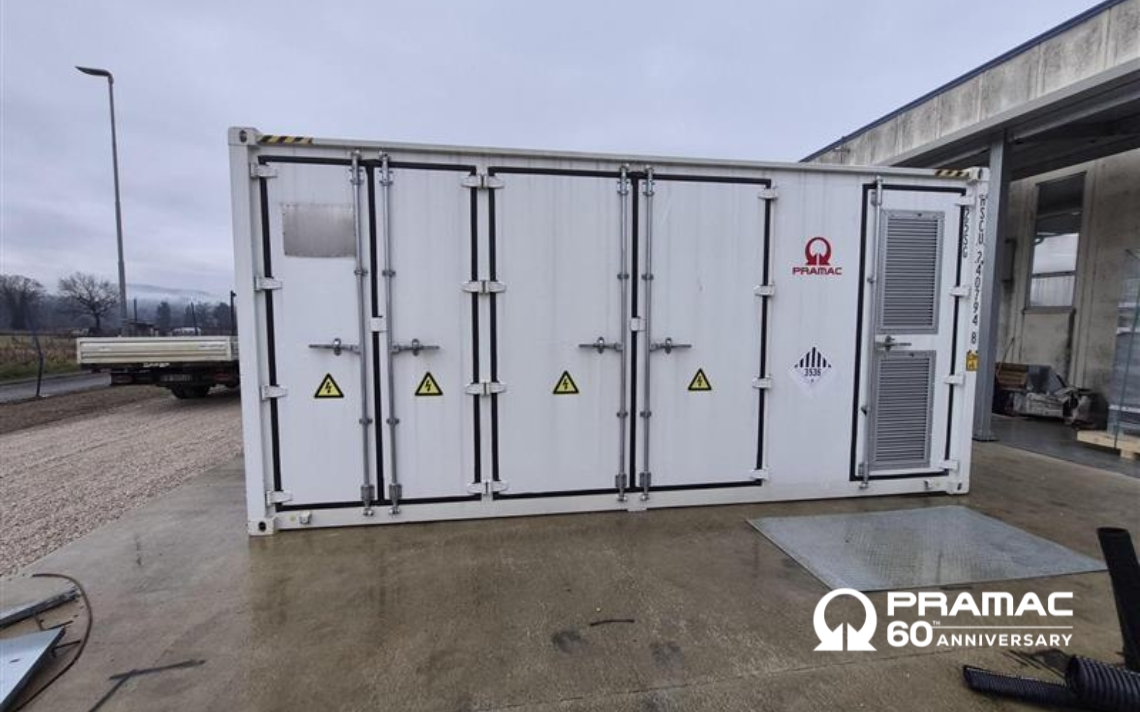
The solution implemented involves the installation of a Pramac Battery Storage Container 20ft – BSC 1056 kW / 2258 kWh, a high-performance storage system designed for industrial applications.
The BESS integrates seamlessly with the existing electrical infrastructure and is managed by Pramac’s proprietary EMS, which defines and implements operating strategies based on the company’s operational needs and energy objectives.
Benefits obtained
The adoption of the storage system has yielded numerous tangible benefits:
1. Increase in available power to power new machinery and test benches, thanks to peak management and dynamic load support.
2. Reduction of the impact of power peaks on the grid supply, with a more stable, regular and predictable consumption profile.
3. Improved operational continuity and reliability, avoiding interruptions or limitations to production and testing activities.
4. Energy cost optimisation through arbitrage strategies and intelligent energy management defined by the EMS.
Conclusions
The case study demonstrates how the integration of an advanced energy storage system can provide an effective and immediate response to the limitations of the electricity grid, especially in energy-intensive industrial contexts. Thanks to Pramac’s BESS and proprietary EMS, the company has been able to increase its production and testing capacity without waiting for external infrastructure interventions, transforming a critical issue into an opportunity for innovation and energy efficiency.
Interested in our Commercial & Industrial Storage solutions? Get in touch now! Click Here